

How to Apply for the DTV Visa Through Muay Thai: The Real Process, Step by Step (2026)
A lot of DTV guides online are written by people who have never trained in Thailand or sent a student through the process. This one is different. We've been issuing DTV Soft Power documents since the visa launched, and Phuket King was one of the first accredited gyms in Phuket to do it.
This is what applying actually looks like, from buying your course with us to getting through the door at the gym. No fluff, and nothing sugar coated.
Rules are correct as of September 2026. Embassies change their requirements often, so always check your own embassy's website before you apply.
First: What Changed on 31 August 2026
Two big changes came in on 31 August 2026, and they affect everyone applying from now on.
- You must apply in your country of residence. You now apply through the Thai embassy or consulate for your country of nationality, or the country where you are a permanent resident. No more flying to Vientiane or Penang to apply there. A tourist stamp, hotel booking or temporary work permit does not count as residence.
- You now need a police check. You need a police clearance certificate from your country of nationality or the country you apply from. It must be in English or Thai, or come with a certified translation. Some embassies accept one up to 6 months old, while others want it within 3 months.
We made a video breaking down both changes. Watch it here.
Step 1: Choose Your Course
You can't get a DTV without a real training commitment, and embassies are paying closer attention to what you buy. Short, cheap courses are more likely to be questioned. Longer commitments generally carry more weight.
We don't sell paperwork. We sell training. Every DTV document we issue is backed by a real course that you're expected to attend.
For people who want flexibility, we've launched the DTV Group Class Pass:
- 60 group Muay Thai classes
- 12 months to use them
- Come and go as you like. Travel for a month or two, then come back and pick up where you left off
- Your 12 months start from your first class, and that class must be within 3 months of purchase
- Group classes only. Open gym and fitness zone access are not included
See full details of the DTV Group Class Pass
Step 2: Pay and Receive Your DTV Documents
Once your course is paid in full, we send you everything the embassy needs from the gym side. This includes:
- Your acceptance letter with your course details and dates
- Your payment receipt
- The gym's official registration and accreditation documents
Tip: Tell us your planned arrival date before we issue your letter. The dates on your letter should match your application.
Step 3: Get Your Bank Statement Right
This is where most people get caught out.
- You need at least 500,000 baht (or the equivalent in your currency) in your account.
- Most embassies want to see around 3 months of statements, with the balance held the whole time. Some ask for less, some for more. Check yours.
- It needs to be an official statement, stamped by the bank or digitally certified. Screenshots from your banking app won't cut it.
- It should be a normal savings or current account. Don't rely on crypto, investment accounts or credit limits.
The big mistake: moving a lump sum into your account the week before you apply. Embassies want to see money that's been sitting there. A sudden deposit looks like borrowed money and is one of the most common reasons for rejection. If you need to move funds, do it months ahead.
Step 4: Get Your Police Check Early
Start this as soon as you've decided to apply. Police checks can take anywhere from a few days to several weeks, depending on your country. For example, a UK police certificate usually takes 10 to 20 working days as standard.
Don't get it too early either. If your embassy wants it within 3 months and yours is 4 months old, it will be rejected.
Step 5: Gather Everything Else
Along with your course documents, bank statement and police check, you'll usually need:
- A passport valid for at least 6 months, with blank pages
- A recent passport photo on a white or light background
- Proof of residence in the country you're applying from
- Your accommodation plans in Thailand
- Proof of travel plans or a flight booking
Scan everything clearly. Blurry or cropped documents slow things down and can lead to extra requests.
Step 6: Submit Your Application
Most applications go through the official Thai e-Visa website (thaievisa.go.th), under the embassy for your country. The fee is around 10,000 baht, paid in your local currency, and it isn't refundable.
Processing usually takes between a few working days and a few weeks, depending on the embassy and how busy it is. Apply at least 4 to 6 weeks before you want to travel, and don't book anything you can't change until your visa is approved.
Step 7: After You Apply
Sometimes the embassy comes back with questions or asks for more documents. This is normal and doesn't mean you'll be rejected.
This is where we help. We support you and give advice through the whole process, from choosing your course to answering follow-up requests from the embassy.
If you are rejected, it's almost always because of the application itself: the bank statement, a missing document or an outdated police check. That's why getting Steps 3 to 5 right matters so much.
Step 8: Entering Thailand
Your DTV is approved. It's a 5-year visa with stays of up to 180 days per entry. Now you need to get through immigration.
An approved visa lets you ask to enter Thailand. It doesn't guarantee you'll be let in. The immigration officer at the airport makes the final call, and that's why it pays to arrive prepared.
Put together one neat folder with printed copies of:
- Your DTV approval (the visa approval document from your application)
- Your acceptance letter and receipts from our gym
- All your other application documents, including your bank statements and police check
And have the standard entry requirements ready:
- 20,000 baht in readily available funds. Cash is the simplest way to show it.
- An onward travel ticket: an open return flight, or a train or bus ticket to another country.
- Proof of where you're staying once you arrive, like a booking confirmation or rental agreement.
You might not be asked for any of it. Plenty of people walk straight through. But these are real entry requirements, and you don't want to be the one standing at the counter scrolling through your emails. If an officer asks, you hand over the folder and you're through.
Respect the visa. Respect the Kingdom.
Getting a DTV doesn't put you above the law. You're a guest here. Follow Thai law, respect the culture and the people, and use the visa for what it's for. The DTV exists because Thailand chose to open its doors to people who want to live, train and learn here. Every holder who abuses it makes it harder for the next person, and every holder who respects it helps keep that door open.
Step 9: Train
Now the fun part starts. Come to the gym, take your first class and your 12 months begin. Train hard for a few weeks, travel, come back and keep going. What is important when you start Muay Tha?
Re-entering Thailand: Most DTV holders re-enter without being asked about their training, but it's smart to be ready. Keep your acceptance letter and receipt with you, along with photos from training. Where possible, we'll help with anything you need to show at immigration.
Refunds and Your Visa Outcome
Our standard refund policy covers all our packages, including DTV courses. Your visa outcome doesn't affect your purchase or your refund terms. Your course and refund terms stay the same whether your DTV is approved, rejected or delayed. Embassy fees are paid to the embassy and are never refundable.
We tell you this upfront because we'd rather you apply prepared than apply hopeful.
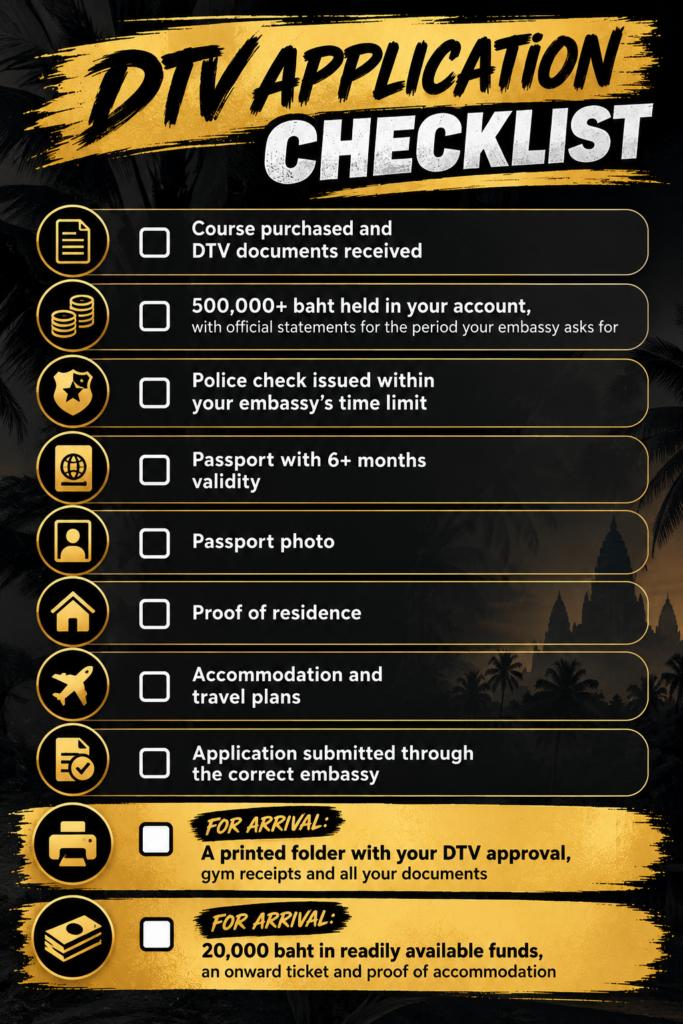
Quick Checklist
- ☐ Course purchased and DTV documents received
- ☐ 500,000+ baht held in your account, with official statements for the period your embassy asks for
- ☐ Police check issued within your embassy's time limit
- ☐ Passport with 6+ months validity
- ☐ Passport photo
- ☐ Proof of residence
- ☐ Accommodation and travel plans
- ☐ Application submitted through the correct embassy
- ☐ For arrival: a printed folder with your DTV approval, gym receipts and all your documents
- ☐ For arrival: 20,000 baht in readily available funds, an onward ticket and proof of accommodation
DTV Visa FAQs
Can I get a DTV visa for Muay Thai training?
Yes. Muay Thai is one of the approved Soft Power activities for the DTV. You need to enrol in a course with an accredited gym, and the gym issues the documents you need for your application.
How much money do I need for a DTV visa?
You need at least 500,000 baht, or the equivalent, in your bank account. Most embassies want to see around 3 months of official statements showing the money was held the whole time.
Do I need a police check for the DTV visa?
Yes. Since 31 August 2026, you need a police clearance certificate from your country of nationality or the country you apply from. Some embassies accept one up to 6 months old, while others want it within 3 months.
Can I apply for the DTV visa from a neighbouring country?
Not anymore. Since 31 August 2026, you must apply in your country of nationality or permanent residence.
What do I need when entering Thailand on a DTV?
Bring a folder with printed copies of your DTV approval, gym receipts and application documents. You also need 20,000 baht in readily available funds, an onward travel ticket and proof of accommodation.
Do I get a refund if my DTV visa is rejected?
At Phuket King, your visa outcome doesn't affect your purchase or your refund terms. Our standard refund policy covers all our packages.
Ready to Start?
If you want to train in Phuket on your own schedule, the DTV Group Class Pass was built for you. Questions about your situation? Message us and we'll give you a straight answer.
Check our Muay Thai camp builder here, get an instant quote on training and staying..